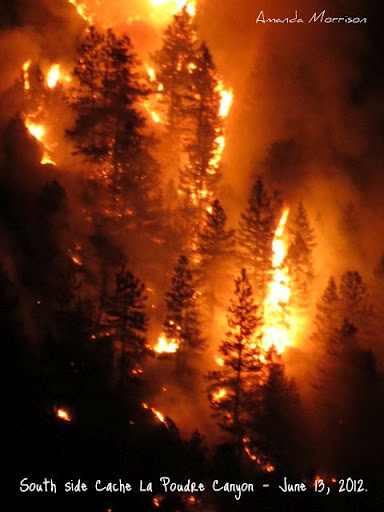
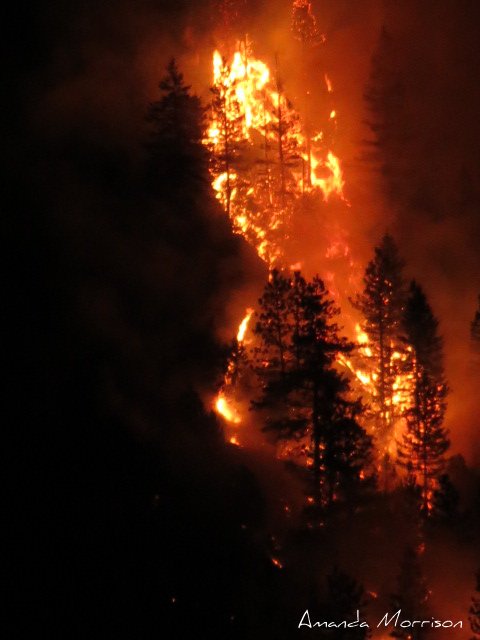
The High Park Fire burn area is one of the most fascinating places I have been to! While I was very fortunate to see the forest fire in action, the fire as we know it burned out of control for about a month and was finally 100% contained in early September. It was captivating to watch entire trees torch up from base to meristem (the very top point of growth for those non-plant nerds) and to witness flames consuming the dead and fallen leaf litter that had accumulated on top of the soil for many years. This all happened relatively quickly. Fire is this crazy thing that ignites, runs like crazy, and dies out. It’s “life” is actually very short.
But what about the actual life that returns to an area that is burned? Doesn’t that take a long time to come back? And just how long is a long time?
Here are my observations to help answer that question.
2.5 months post-fire. Moderately burned area meaning the grasses, litter, and most of the tree burned. Note all of the grasses and forbs growing.2.5 months post-fire. Moderately burned area. Everything on the ground and trunks of the trees burned. These trees are not likely to survive.2.5 months post-fire. Moderate burn area. Paintbrush thriving in nutrient rich soil among grass species that have come in fairly dense.3 months post-burn. Moderate burn area. Mullein and sedge are abundant and throughout this burn site.3 months post-fire. Severely burned slope. Note lack of green (vegetation).3 months post-burn. Severely burned area where everything burned. Note the spotty vegetation (a forb) growing here.3 months post-burn. Severely burned area. Forbs are growing next to rocks and fallen burned trees, likely because water collects here.3 months post-burn. Severely burned area. Sedges have grown from seed.
As you can see from the photos I have taken at various sites within the greater burn area, seeds do not take long to respond and send up shoots. This is of course dependent on water availability, sunlight, and nutrients. It is also dependent on how severe the burn was and how deep it impacted the soil and the seeds within it.
It is absolutely breath-taking to wander through a recently burned area and see the changes that are taking place. I am surprised at how quickly plants and animals have returned to something that from a quick glance with the human eye appears to have nothing to offer. It is a lesson in pausing to look more closely to observe what is happening around us. Change constantly happens, always affecting something or someone. And that is a pretty powerful and phenomenal thing!
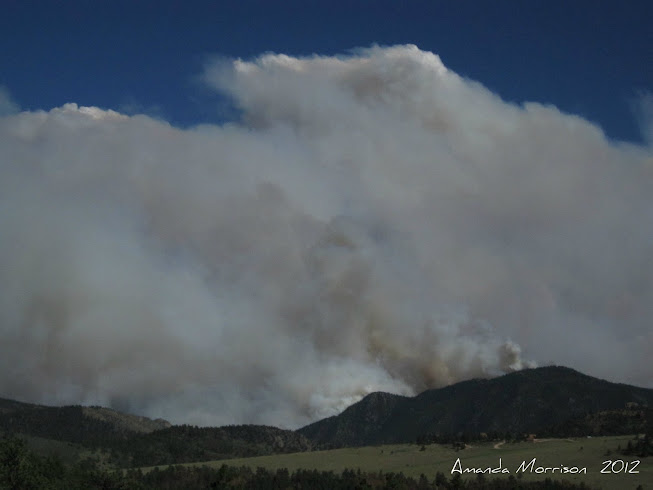
Three months ago, my quiet little town of 140,000 people woke to a plume of smoke rising above the hills, catching the wind to Wyoming and Nebraska. The High Park Fire exploded that day, and the next, and the next, burning the foothills forest northwest of my town and throughout the beloved Cache La Poudre Canyon, taking with it nearly 300 homes located within the these areas.
Now maybe most people feel fear, anxiety, or sadness when an uncontrolled wildfire rips through an area, particularly when their home is at risk of being lost. I can only imagine how my friend who lives in one of the evacuated areas was feeling those 2 weeks that he was waiting to hear if he would have a home to go back to; how do you quickly accept the fact that you may lose the house you have bought and the land you have worked on for so many years at any moment?
But, if you know me or have read my blogs, you know that I am not most people.
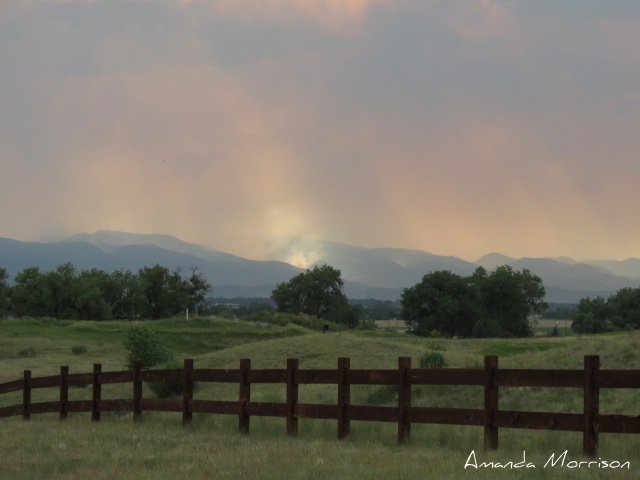
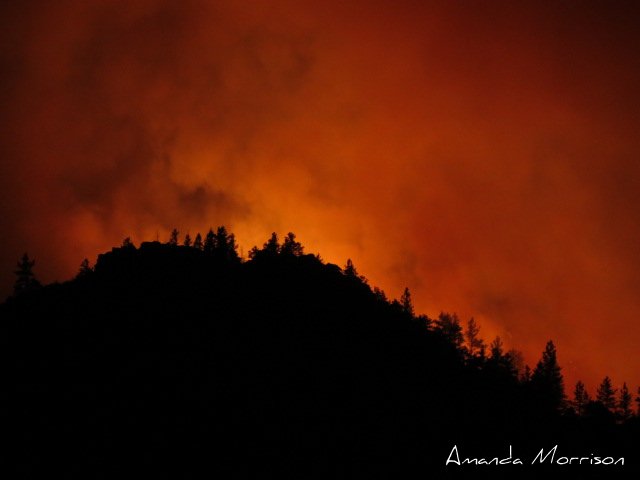
If only I could share with you the adrenaline rush that I experienced when I first saw the smoke plume that Saturday morning! It was as if a spark had been lit beneath me and I became extremely restless and anxious. Not in a stressful way but in a hyper-excited, curious way where for 2 weeks I obsessively thought about the fire, watched the fire, and talked about the fire. I was practically dancing around with joy, informing all who would listen that regeneration was going to be allowed to finally occur and is this not THE MOST exciting thing that has happened to the local ecosystem in years??!! How INCREDIBLE that we are able to witness an event such as this in our lifetimes!! I could not get close enough to it, I could not stop photographing it, I could not wait to get near it to watch its power, see the magnitude, and experience its ability to change the landscape as we have known it.
Please enjoy the photos that I have taken to capture this grand event. Photos that are close to the fire were taken on the north edge of the Cache La Poudre Canyon less than 1 mile away, just south of where the fire jumped the canyon from south to north side at Steven’s Gulch. The other photos were taken either from a friends’ house 2 miles away from the fire or somewhere between 5-30 miles away. Please do not pilfer the photos, as I prefer that you just share my blog page with those whom you would like to see them.
Ten days on the tundra. This was an experience I never imagined that I would have but thanks to my involvement on a science research project at Colorado State University and my amazing boss, I was given this opportunity of a lifetime. There is something special about bringing a group of strangers together for a common purpose, getting to know these folks in ways we would not otherwise know them had we not been together in one of the most remote places in North America, and making connections with each other and our work that will continue long after we have separated.
For me, this trip did more than allow me to worry non-stop about the 8 teachers who travelled and worked with us on the pluck. It allowed me to learn some things about myself.
#1. I am not used to other people taking care of me. When I was injured and could not carry my own bags, everyone helped me and watched out for me. I felt like I had 11 parents all there to make sure I was taking care of myself and being safe. This was amazing to me and very difficult as I am usually the one caring for others. I learned that it is okay to let others give a hand, even if I do feel helpless and kind of like a wimp.
#2. Field work and learning are my passions. I spend most days sitting in an office at a computer helping to manage people and projects, which I am generally happy doing. I feel that I do this well and for now it is a good thing for me. Being back in a lab with my hands in the soil, out on the tundra learning new research methods, and being immersed in a natural environment, brought more life back into my life. At Toolik I felt like I was where I should be, with people I belong with, doing what matters the most to me. It was here that I felt connected to people and my surroundings, as part of a community and as a piece of the ecosystem.
#3. There is no substitute for experience. You can read all you want about doing something, study my blogs and listen to the stories others tell about their experiences, and convince yourself that you know what it is all about so there is no reason to go do it yourself. But until you are watching a herd of caribou stepping clumsily around tundra tussocks, watching a sun that doesn’t set, or feeling the weightlessness of a lichen between your finger-tips, you don’t know. Until you are gazing across the biggest landscape you can imagine, getting a twinge of fear that makes you so dizzy that you want to puke because you realize how insignificant and yet how powerful you are, and trying to come to terms with this, you don’t know. It changes you in a deep and profound way that I cannot even attempt to put into words.
A sight that had my jaw dropping to the ground at 10:30pm.
This journey is now a part of me. From the very beginning it has been shaping me, giving me new perspectives, understanding, and meaning.
THANK YOU to everyone who was involved: John M., Laura G., Gus S., Dave S., Mary H., Brad B., Aki K., Greg S., Mary G., Marty B., Lisa W., Jasmin C., and David W. Special thanks to Rachel who shares my love of running and to Gretchen for being the best washer tournament partner. And lastly, a shout out to Tim from Purdue who asked for some of my moon and mountain photos, which made me feel like I do actually know how to operate a camera!
Walking out the door of the Deadhorse General Store, I knew right away there was no way we were going to take off that night. The fog had become thicker than just an hour earlier when we had arrived at the small airport and unloaded our luggage. I could see across the dirt road but no further and figured I’d better start thinking about plan B.
Being opportunistic has benefits and one of those is that you are always looking for ways to make a potentially bad situation better. As the airline representative announced that our plane could not land and that we were to be booked on the next day’s flights, I cheered out loud. Others groaned, viewing this as a burden rather than an opportunity to spend more time in a place they will most likely never return to. I was thrilled to be booked on the 5:00pm flight rather than the 9:30am flight, because this meant I got to spend an entire day in Prudhoe Bay.
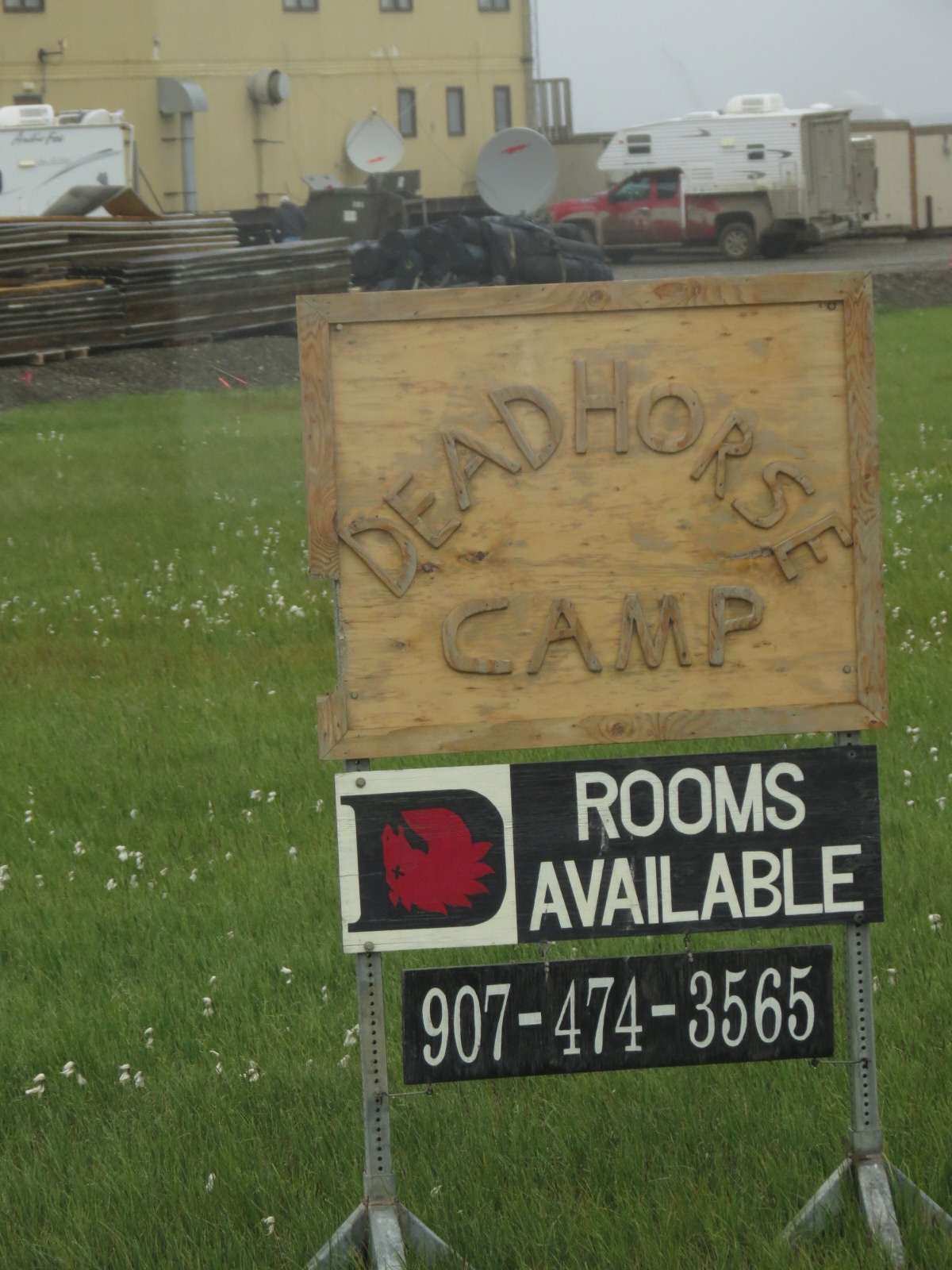
Arrival at Deadhorse Camp.
Because of the fog delay, a new adventure started! One of our contacts back at Toolik Lake called a friend who arranged for us to come to the work camp that she works at. For $200 per night (places to stay, of all qualities, run about $200/night in Alaska) we could stay in a work trailer dorm and get dinner and breakfast, plus a ride to and from the airport. We were extremely lucky to find this as the one hotel in town was booked and our group of 13 was on the waiting list, meaning we were likely to end up sleeping on the floor in our sleeping bags in the hotel’s t.v. room.
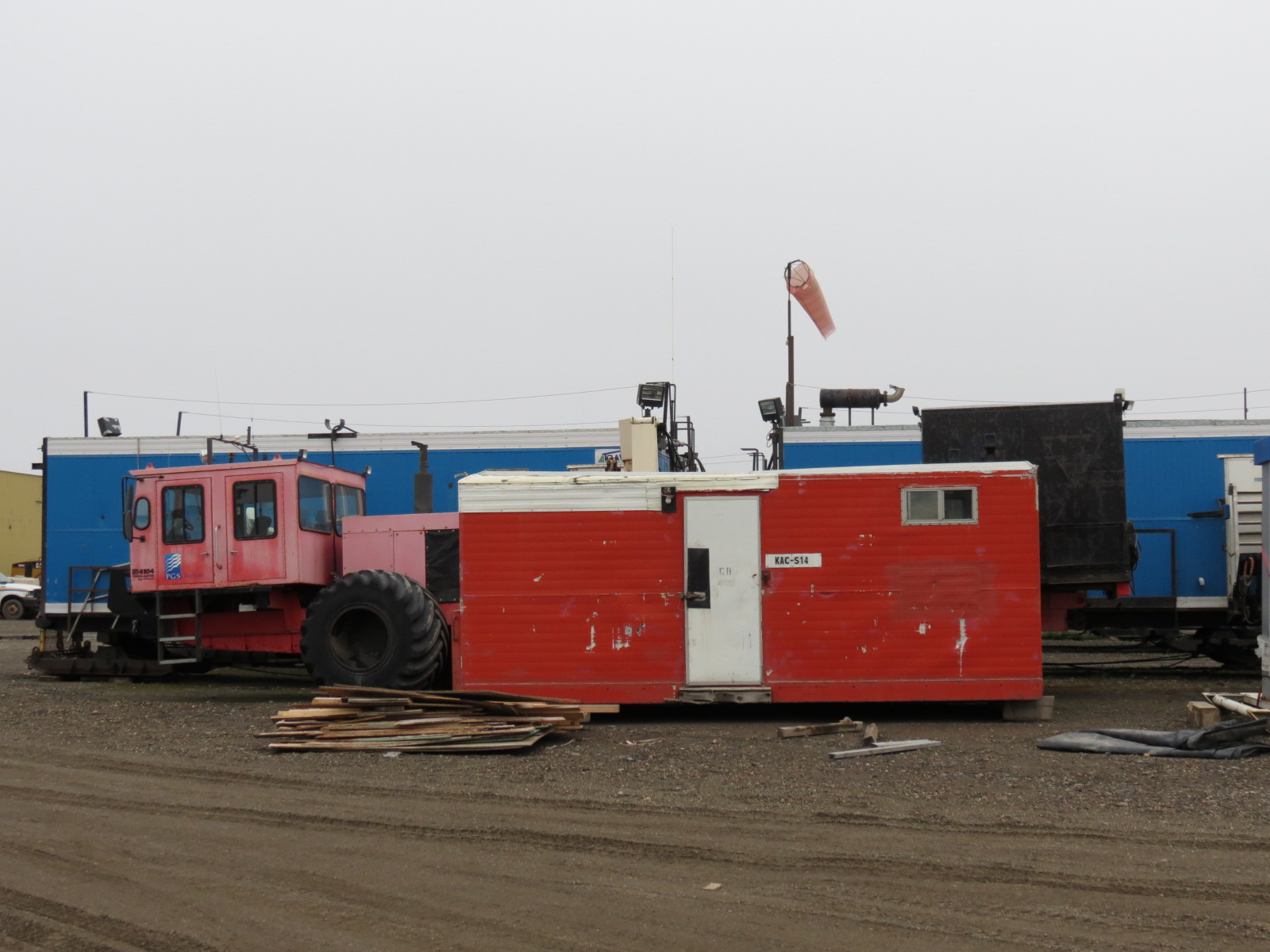
Deadhorse Camp is literally a bunch of work trailers, a garage, and rows of heavy machinery stored on a gravel pad out on the arctic coastal plain. There are large trucks of all kinds and SUVs parked near every building. Buildings are surrounded by piles of wood, metal in all forms, and either earth moving machinery or mobile trailers on skis made to travel across the frozen ground. Clearly this is a place for hardy people doing work in a hostile environment.
At 64 feet above sea level, the ground alternates between coastal grasses and sedges and pools of water on which many species of water birds can be found. It is so swampy that in order to have buildings that don’t sink, tons of gravel is brought in to create stable ground on which buildings are placed. The roads are also gravel bars built up to 10 feet high above the water and vegetation.
At dinner we meet a fascinating man who is staying at camp while working for NOAA through a school in Tennessee. His job is to fly with a small plane pilot out over the Arctic Ocean along 60 mile transects each day. During these flights he records the marine life that he sees, and this information is then used with nearly 20 years of data collected by those in the oil industry to show whether or not drilling here impacts the wildlife. He spends 30 minutes with me giving pointers and ideas about where I should camp and hike a week from today near Seward which gets me fired up for the next leg of my great Alaskan adventure.
What luck! I think to myself as I walk across the pad to my room. I can just feel the big grin plastered across my face.
Mushrooms grow among mosses and Ledum plants as part of the tundra.
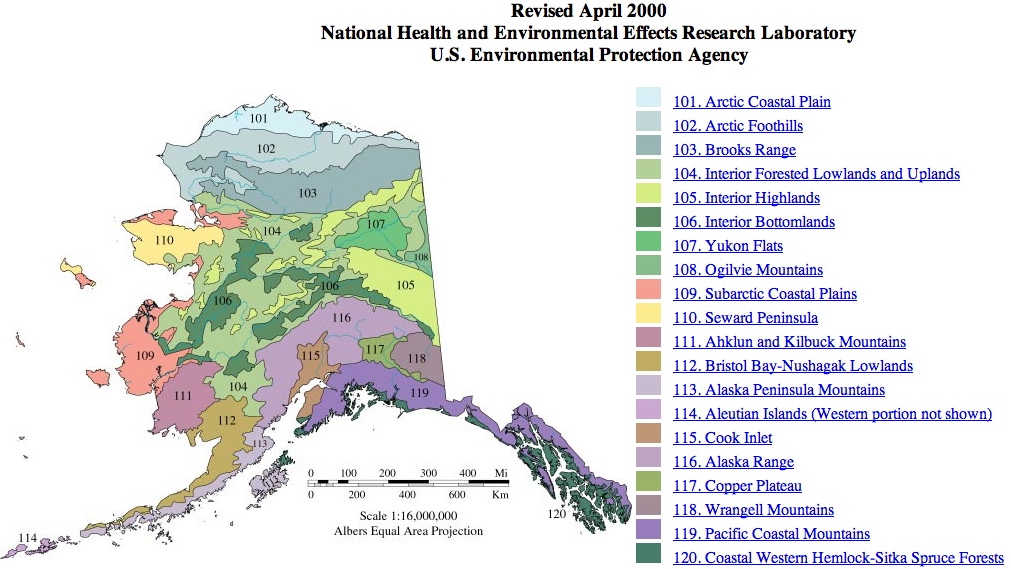
The word tundra refers to treeless ecosystems where winters are long and cold, and summers are short and cool. It comes from the Finnish word tunturi which means treeless plain. Where trees stop growing at the northern latitude of about 65 degrees North, the biodiversity of plants and animals decreases. From here north to about 72 degrees latitude live low shrubs, lichens, mosses, sedges, and grasses. Our location at Toolik Lake is roughly 68 degrees North latitude and in the Arctic Foothills ecoregion.
Wildlife sightings are not so common as species like caribou, wolves, musk ox, dall sheep, lemmings, and voles are spread out over the vast expanses of land here. We were fortunate to see many bird species and a herd of caribou but most often we saw evidence such as scat, antlers, or burrows that told us these animals were here.
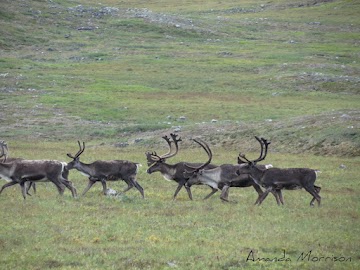
Caribou wandering the tundra in a small herd.
On a day trip south over Atigun Pass in the Brooks Range we were fortunate to spot dall sheep on a distant cliffy mountain. Short-eared owls seemed to be in abundance in the lower lands, hunting voles and lemmings from a few feet above the vegetation. A herd of roughly 200 caribou passed by the northeast edge of the field station one morning, giving us all a great look at the different ages and sexes of these animals. On a bike ride north of the lake I was fortunate to see a bull moose hi-tailing it across the tundra.
In Toolik Lake live the Arctic Grayling, a cold-water fish species closely related to salmon and trout. On one of the work days, one of our teachers was able to go out with the fish sampling crew to help with fish capture. That same day I was fortunate to be out with the aquatic invertebrate crew to sample insects [hatching and living] above the river that are thought to be what the fish are feeding on in late summer.
Ecoregions of Alaska
As one moves north and into the Arctic Coastal plain, the plant and animal diversity changes. Read more about that in my next post.
At first glance, I was disappointed by the birds I was seeing at Toolik Lake. American Robins. White-crowned Sparrows. Seriously?! I can see those at home on any given day. With great hope, I looked at the bird list on the University of Alaska’s website for the station but frowned at the number of birds here that also live where I live in Colorado. It was the majority.
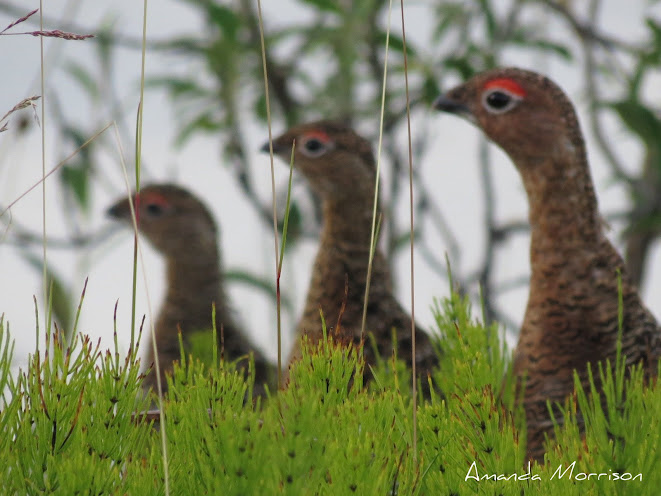
Willow Ptarmagin hiding in willows.
Part of my birding snobbery comes from the fact that I am in competition with my friend Todd this year. Last winter he pestered me to keep detailed accounts of the birds that I see, stating over and over again that it is important to keep track of such things. I refused for months to participate in this activity because I know myself and how competitive I am. If I was going to keep track, I was going to need lots of motivation and I was going to have to beat the pants off of him!
A couple days into the trip, I took a photograph of a bird I did not yet know. It was a small brown bird with a raspberry red tuft of feathers on its forehead. It stared me down with a steady and serious look that seemed to say, “I will take you on!” This small bird motivated me to look at everything that moved on the tundra. I was suddenly tuned-in to every sound and every bit of movement. My view of the tundra was brought down from a landscape scale to an individual organism scale. I started to notice all of the fine details of the tundra, like the differences among mushrooms, tundra plants, small animals and insects. My eyes began to constantly roam the land, water and sky for anything out of the ordinary.
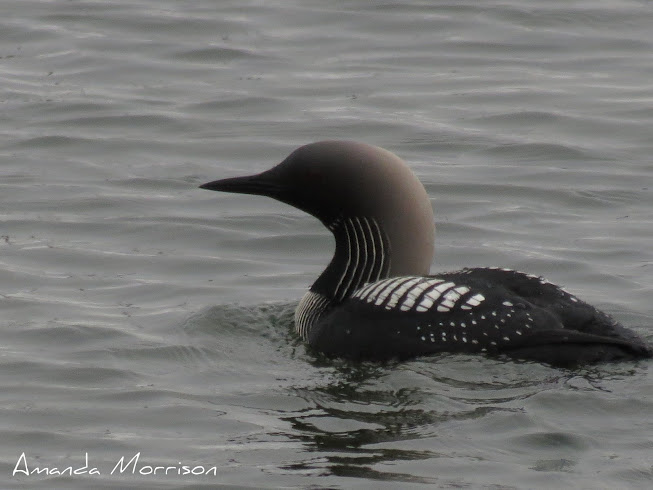
Pacific Loon in pond near Prudhoe Bay.
This, in conjunction with picking through roots, stems and leaves of tundra plants during the pluck, changed my perspective of the tundra. It helped to develop my understanding of this ecosystem and got me thinking about the relationships happening at different scales.
I am up to 171 different species of birds this year, falling short of Todd by less than 100 now. I’m confident that I’ll catch him by December 31st. But if I don’t, I will have still won because it is what you learn along the way that means the most.
This blog is dedicated to Todd Reeves, my favorite birding mentor and companion.
I am the luckiest girl in the world, of this I am certain. On days like these I cannot imagine my life any different, nor would I ever want it to be…
Rescuing a Short-Eared owl chick from the roadside.
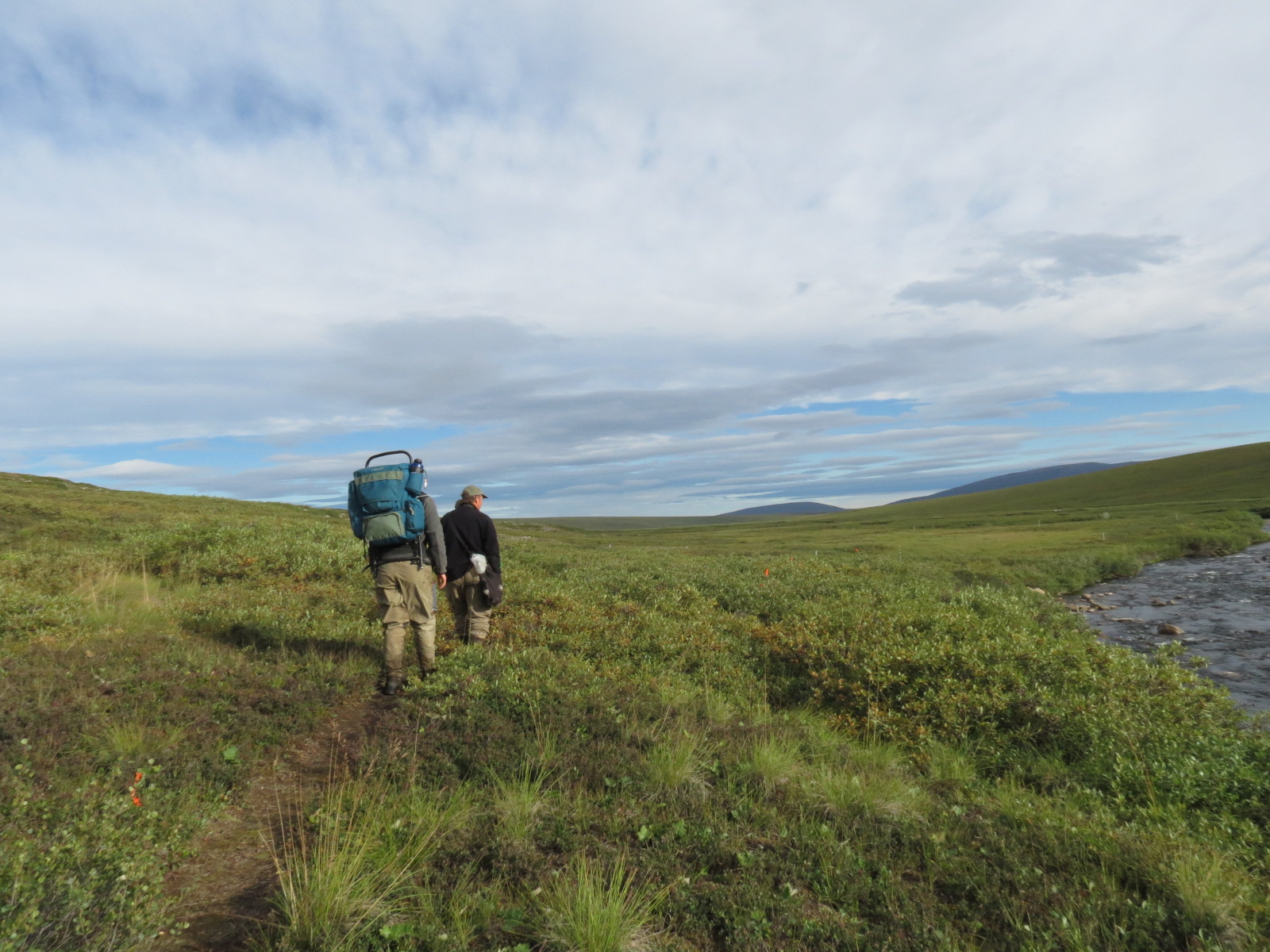
At 8:30am I hopped into a truck and headed north on the Dalton with 2 other workers to join them for the day. We spent the day hiking across the tundra and working alongside the Kuparuk River. This is one of the many rivers that begins in the Brooks Mountain Range and empties into the Arctic Ocean. Our task was to remove sticky traps used to capture insects that live above and alongside the river and replace them with fresh new traps. Lacey is the graduate student who is studying the aquatic invertebrates that live along the river and she is hoping to correlate these to the birds that live along the river, or use the river as a food source in the fall (which is now, the end of July). We spent much of our day changing out traps with the beautiful backdrop of the mountains behind us.
Hiking out to the sample site.
After this work was done, we traveled further north up to Oksrukuyik Creek where we wandered across tundra to the riparian area. Here we attempted to do a bird census (count) but didn’t hear or see a single bird in the tall willows. After giving up on that, we walked up the creek turning over rocks looking for mayfly larvae. We were unsuccessful at that as well but were not concerned as we had seen several mayflies on the sticky traps earlier in the day. Lacey was very interested in this because the mayflies apparently should not be hatching this early and they most definitely are.
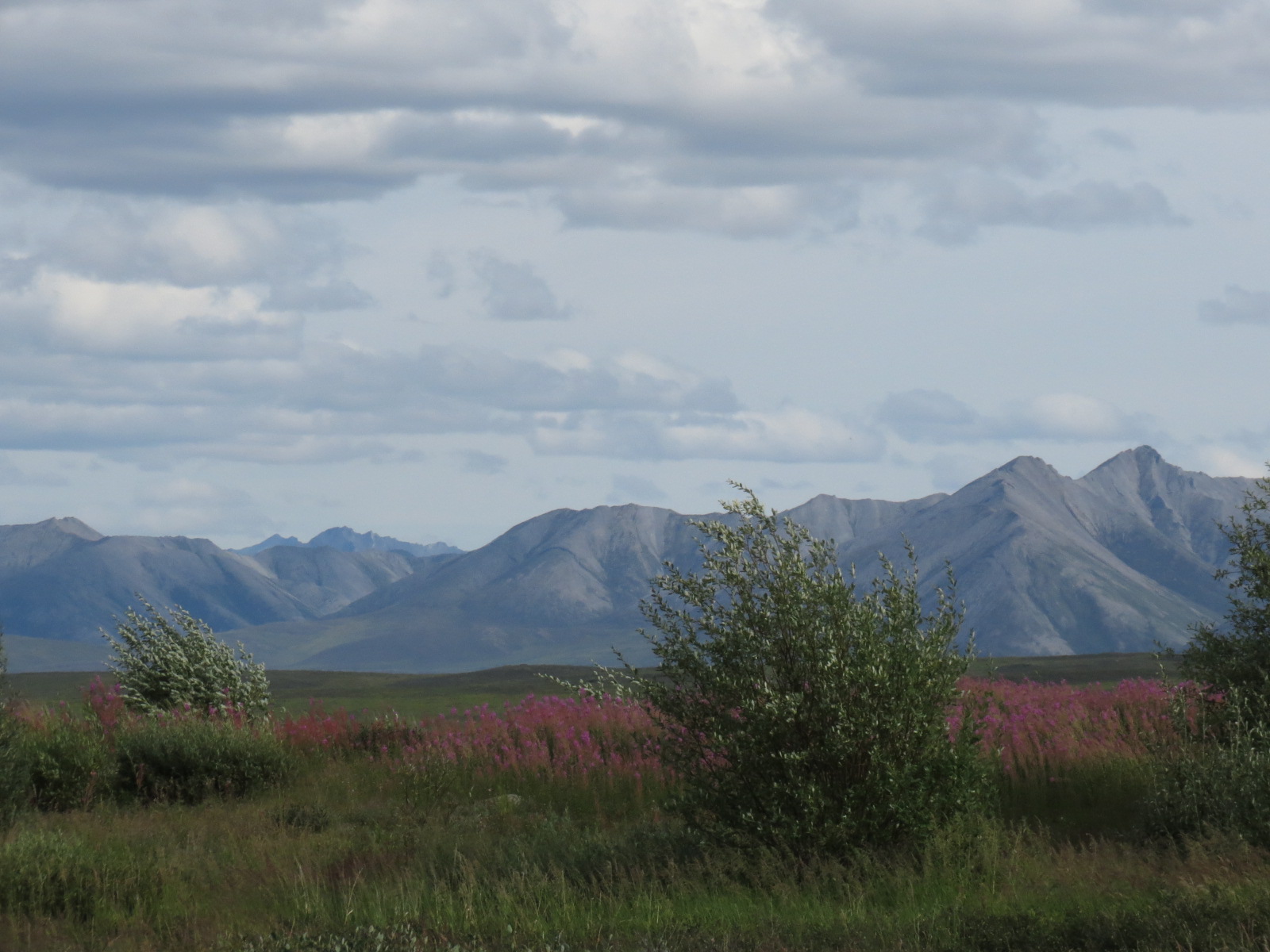
Traveling between sites, we happened upon a number of wildlife sightings. There are no herds of caribou here yet but we did encounter caribou hunters who have come to set up camp and scout the area since the season starts soon. I keep forgetting that it is early fall here, as it is confusing when I see Golden Plover chicks in downy plumage and unable to fly. One only has to look around at the vegetation to tell that it is changing color right now. The blueberries and salmon berries are ripe for picking, their leaves already turning shades of yellow and red. The summer flowers have all gone to seed but the fireweed persists, adding brilliant pink to the still green landscape.
Fireweed grows on disturbed areas near the Alaskan pipeline providing a burst of color.Working diligently to replace sticky traps.
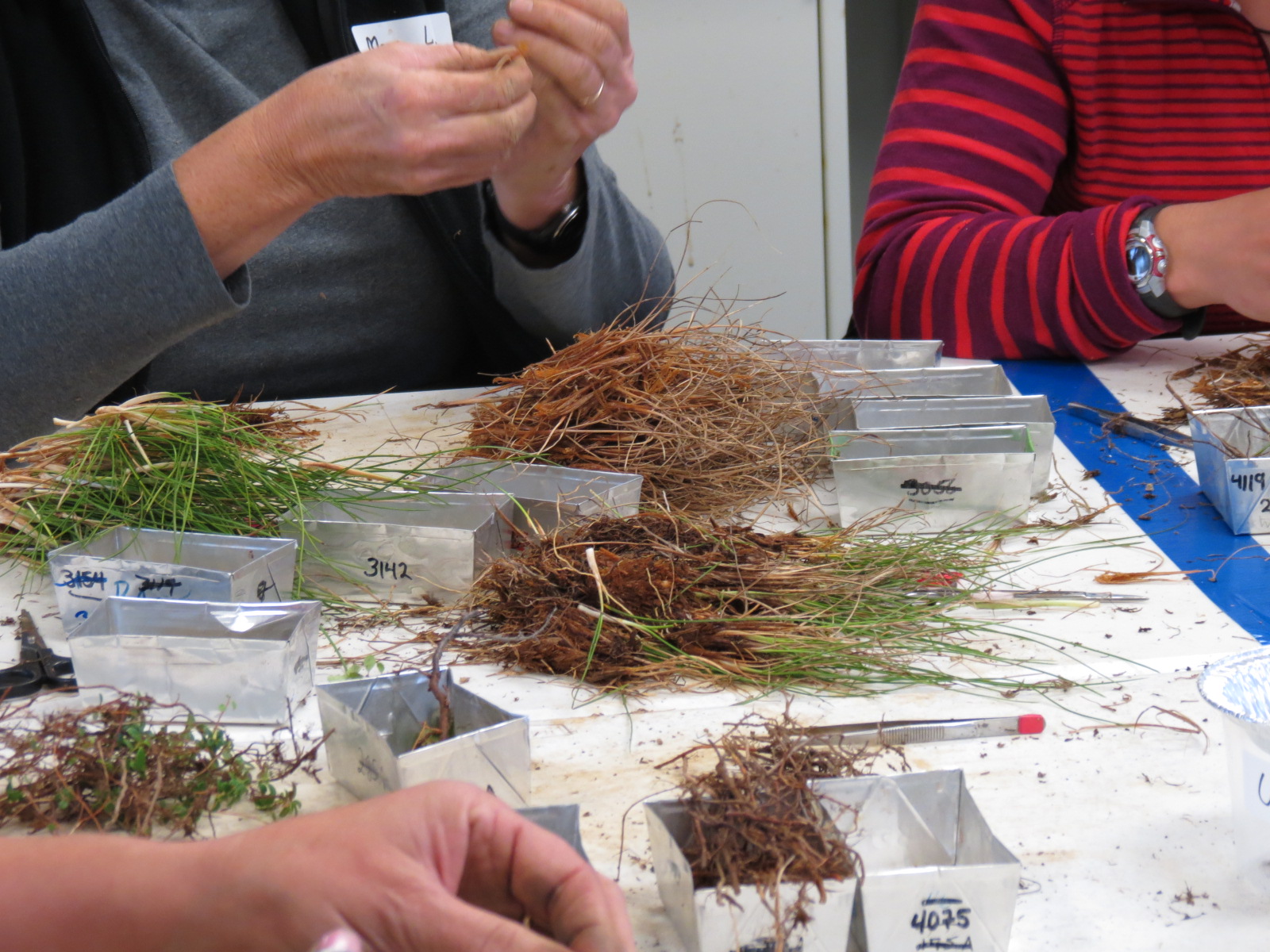
133 miles south of Prudhoe Bay lies the Toolik Field Station (TFS) which is part of the Institute of Arctic Biology, run by the University of Alaska in Fairbanks. Scientists from around the globe travel here to study the tundra. Our crew is tasked with “The Pluck.” We are pluckers for the next 6-7 days, depending on how quickly we pluck. Work begins at 8:30am and ends roughly around 8:30pm with meal times included.
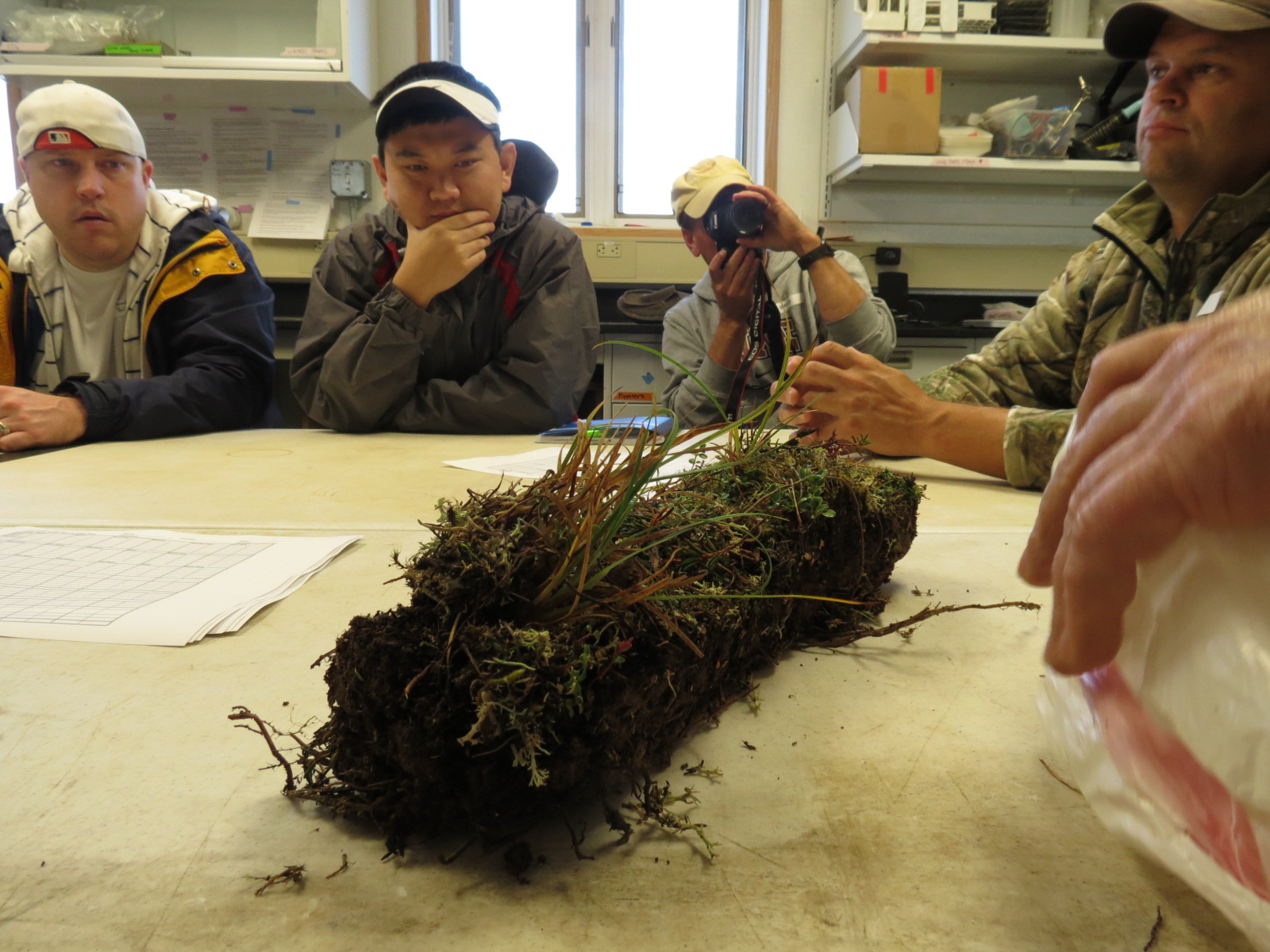
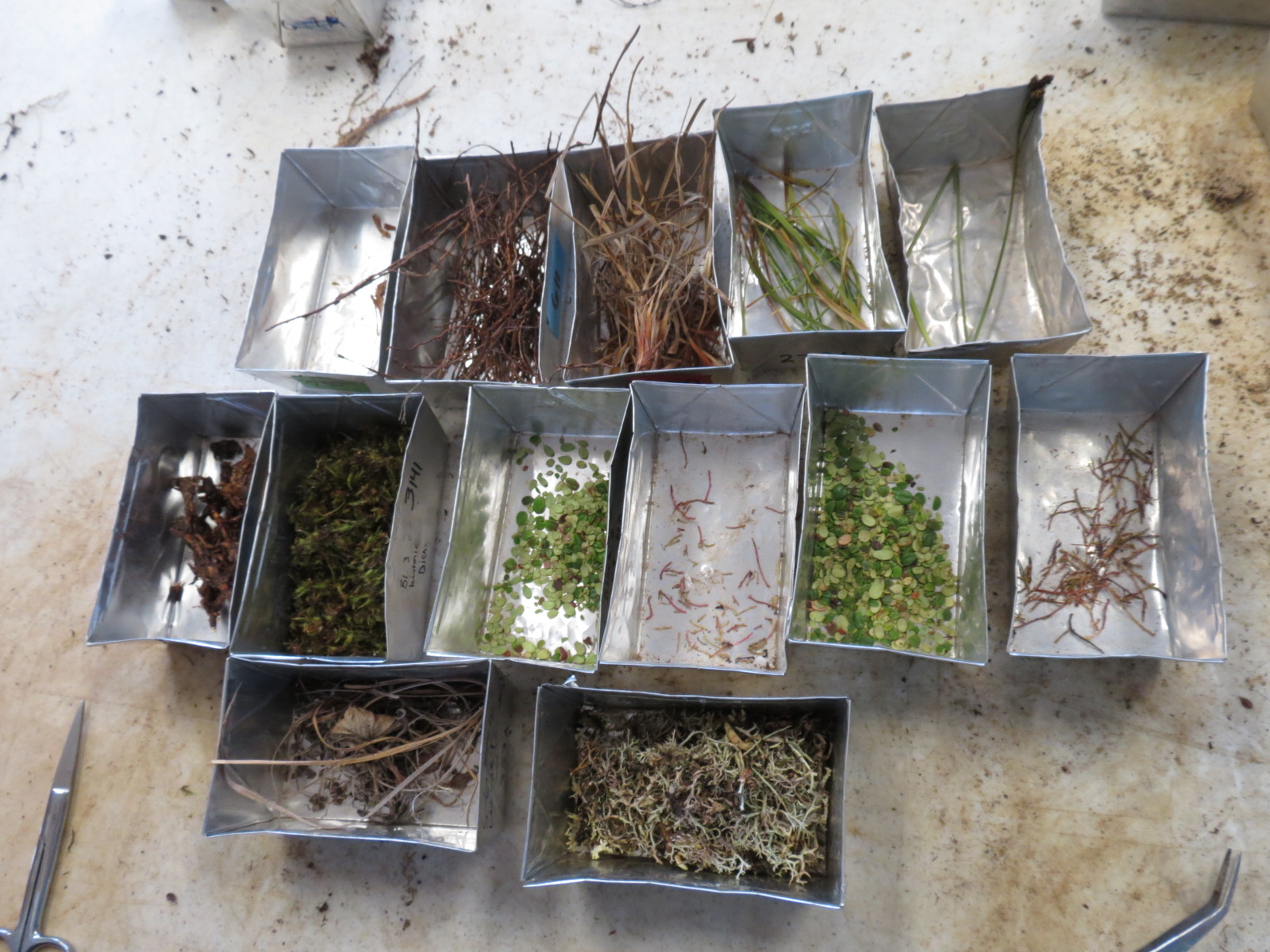
On day one, Gus and Laura take us on a hike atop boardwalks over the tundra to the study site where we take a look at fertilized and unfertilized plots. It is from these that samples of tundra will be taken each day, brought to an indoor lab where we will pluck them apart. We will separate and identify up to 12 species of plants, lichen and mosses. These will then be placed into paper envelopes to be dried and weighed within a few weeks time. This data will help to determine the effects of increased nitrogen on the tundra, one of the things that will increase as global climate change progresses.
Here at TFS scientists are studying everything from carbon dioxide release by plants, surveying fish species in the lake and river, to birds and the aquatic insects they eat. This area has been a part of the Long-Term Ecological Research network which houses nearly 30 sites around the world. Long-term research is critical in order to collect enough data to see patterns or trends, and also aids in complete and valid data. This is my fourth LTER site to visit this year. I am fortunate to have work that has taken me to the Shortgrass Steppe and Niwot Ridge sites in Colorado, as well as the Kellogg Biological Station in Michigan last fall.
So far the weather has been a refreshing 65 degrees each day and about 45 degrees at night. Clouds blanket the sky for much of the day and a couple of nights gave us rain dropping steadily on the weather ports as we drift off to sleep. Since there is 24 hours of daylight, we work until we can and spend the night hours walking the boardwalks, fishing, bird and wildlife-watching, running, biking, and enjoying an assortment of Alaskan brews with new friends.
Twenty-three hours of daylight is an experience I was having a hard time conveying to the arriving teachers who had also not previously been to Alaska. I found myself full of energy and wanting to go out for a run at 11:00p.m. I ate four full meals on my first AK day and have not slowed down my food consumption since.
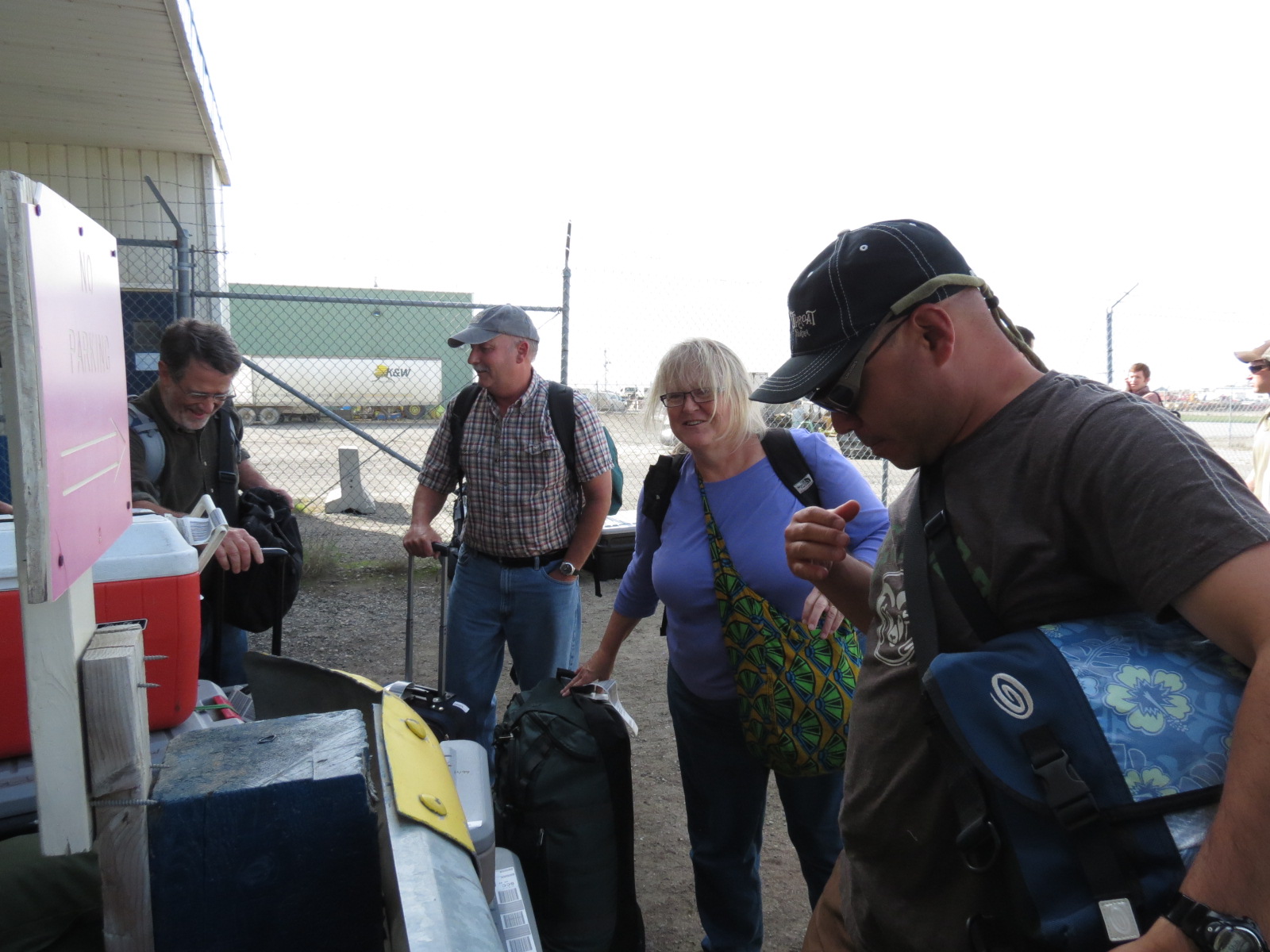
Some of our crew sorts bags and gear at the Prudhoe Bay/Deadhorse Airport.Sunday evening I found myself in the Anchorage emergency room getting an MRI due to extreme pain that had shown up that afternoon. Apparently age 35 was going to show me what it could do. The Doctor assured me that my spine looked perfect and I that had probably just joined the club of millions who suffer from back pain. Of course there was still the issue of the hip and my inability to sit for long periods of time but that was manageable on the tundra with yoga, stretching, and taking walks. Armed with medication and aided by our team of teachers and researchers, I boarded the plane for Prudhoe Bay.
Prudhoe Bay is exactly as you picture it to be. Every photograph is the same photograph that I took in the hour I was there. Google it and look at the photos that come up – they are the same ones I took, since there is so little to take pictures of. This is a minuscule town, so small that upon landing the pilot of our plane told us to “enjoy our work,” because no one actually lives up here, they just come to work. This is no tourist town but rather a region housing one of the world’s largest oil fields which creates a need for transportation. This is made very clear by the infamous Dalton Highway that leads you from the Arctic Ocean south to Fairbanks (think Ice Road Truckers), and the Alaskan Pipeline that runs alongside it. Oil storage tanks at Prudhoe Bay.
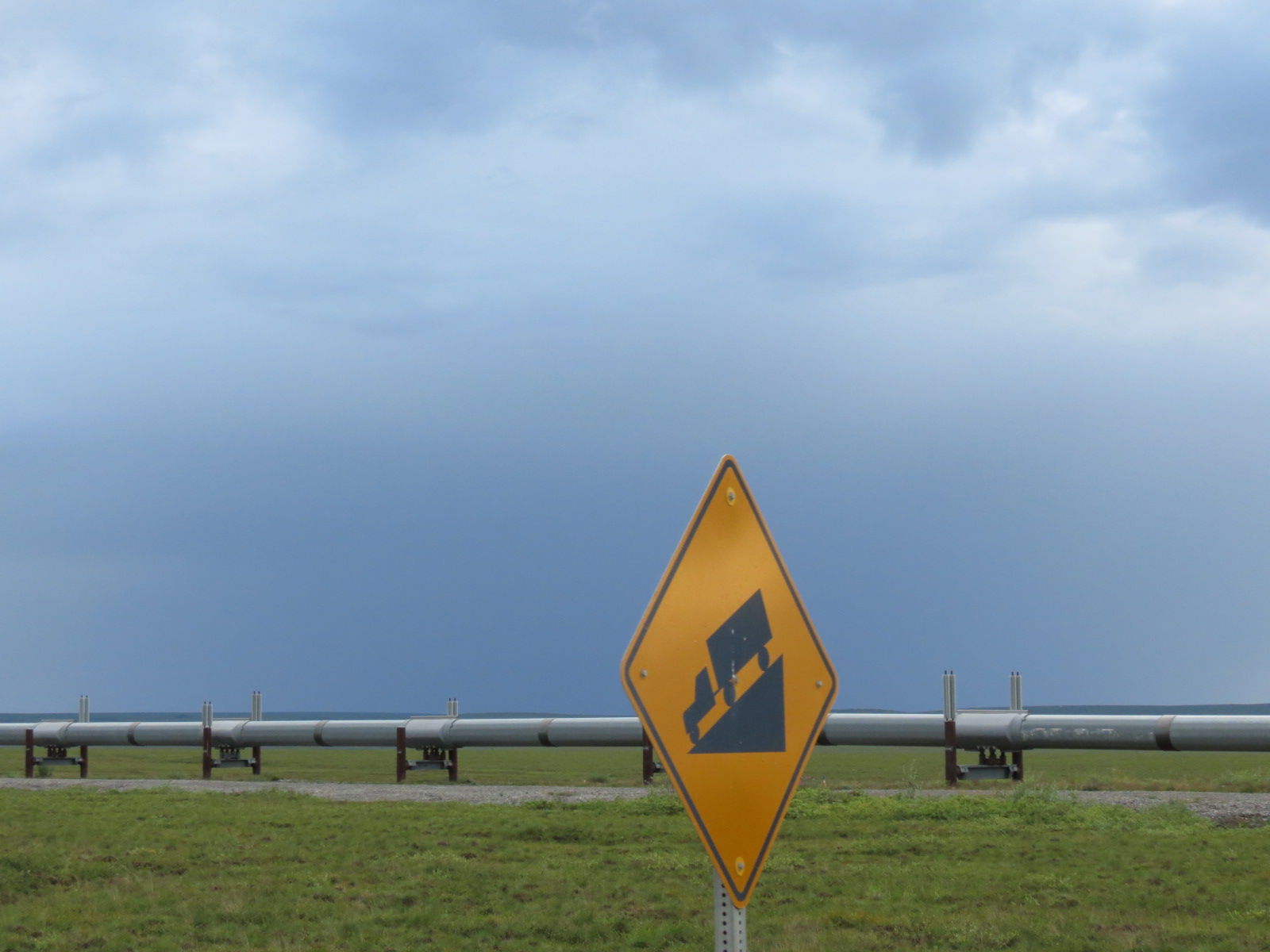
It’s a slow 3 hour drive south to the research station on the Dalton, an elevated dirt road which had to be built because the ground is literally a bog of tussocks and water for hundreds of miles. It reminds me of the cranberry bogs in northeastern Vermont, even with similar plant species. Every vehicle on the highway has a CB radio and as they spot an oncoming vehicle, talk to that vehicle telling them what you want them to do. For example, we were told that a 120-foot truck was heading north and that we needed to pull over as far as we could and stop until it was past us. You don’t argue, just do as told and everyone gets along fine. The Alaskan Pipeline as seen from the Dalton Highway.
We arrive at camp shortly after 9:00p.m. in time to microwave dinner leftovers, sit through a 45 minute welcome and orientation, find out which weather port to call home, and witness our 24th hour of light on July 23rd. We are in the northern foothills of the Brooks Range in Alaska at 68° 38′ N, 149° 36′ W, at an elevation 720 m. And it is glorious!
Two teenage faces stared at me, waiting patiently for an answer as I racked my brain for words that I could use to explain the next 2 weeks to a 14 and 15-year-old. I remembered a workshop I attended for fun at my university last year where scientists and graduate students packed a room for a morning and made painfully slow progress at putting together a 2 minute summary about their research that could be understood by their grandmother, someone from the media, or even their significant other. Communicating Your Science the series was called. I needed to communicate science.
Our conversation took place en route to Anchorage where I was headed in order to meet 8 middle and high school teachers who are flying in on Sunday from Maryland, Michigan, and Colorado. My boss and 2 other researchers will also come and when our team has arrived, we will fly to the Arctic Circle, north of the Brooks Mountain Range. Once there we’ll stay at a research station with about 100 other research scientists and their lab folks, all of whom are collecting data on everything from birds to soil microbes. Our team will be working on soil sampling, sorting and identifying. For two weeks we will have our faces toward the ground, in the field and in tent-like labs. The goal is to better understand what lives in the tundra environment, and what changes are currently happening with the permafrost thawing as our planet warms.
Much to my surprise, the boys’ eyes lit up and I was bombarded with question after question for much of the 5 hour flight. These kids were sharp! And educated well in salmon, whales, migratory birds, and bears. They told me everything they knew about these animals, native Alaskan culture, and described to me how their part of the planet rotates around the sun in an attempt to increase my understanding about 23 hours of daylight in mid-July. After giving me tips on where to see migrating birds, they proceeded to pick apart my working life, probing for details about wildlife research and education experiences I have had. I don’t believe I have ever had a more captive audience or have held anyone’s attention for so long.
The older teen was watching me with my face glued to the airplane window for an hour as we raced above mountain peaks poking through a thick blanket of clouds. Behind me I heard a child ask his father if what he looking at was snow or clouds. A long, snake-like glacier appeared below us, flanked by the two new mountain ranges it was creating, and feeling its power brought tears to my eyes. I turned to look at the teenage boy sitting next to me. He looked steadily at me and with a tiny smile said, “It’s pretty amazing, huh?” Our eyes met and I nodded, unable to communicate what this experience was already making me feel.

 The High Park Fire burn area is one of the most fascinating places I have been to! While I was very fortunate to see the forest fire in action, the fire as we know it burned out of control for about a month and was finally 100% contained in early September. It was captivating to watch entire trees torch up from base to meristem (the very top point of growth for those non-plant nerds) and to witness flames consuming the dead and fallen leaf litter that had accumulated on top of the soil for many years. This all happened relatively quickly. Fire is this crazy thing that ignites, runs like crazy, and dies out. It’s “life” is actually very short.













 The Outside Within